
Handbells Retreat & Keeping God at the Center
This weekend, eleven members of the Red Door Ringers are with me at Lutheridge in the mountains near Asheville for a handbell retreat weekend. We have joined 160 other ringers from across the Carolinas for a weekend of study, worship, rest, and fellowship. The weekend consists of eight hours of intense handbell rehearsal, workshops on technique, and an opportunity for ringers to work with composers and leaders in the world of handbells.
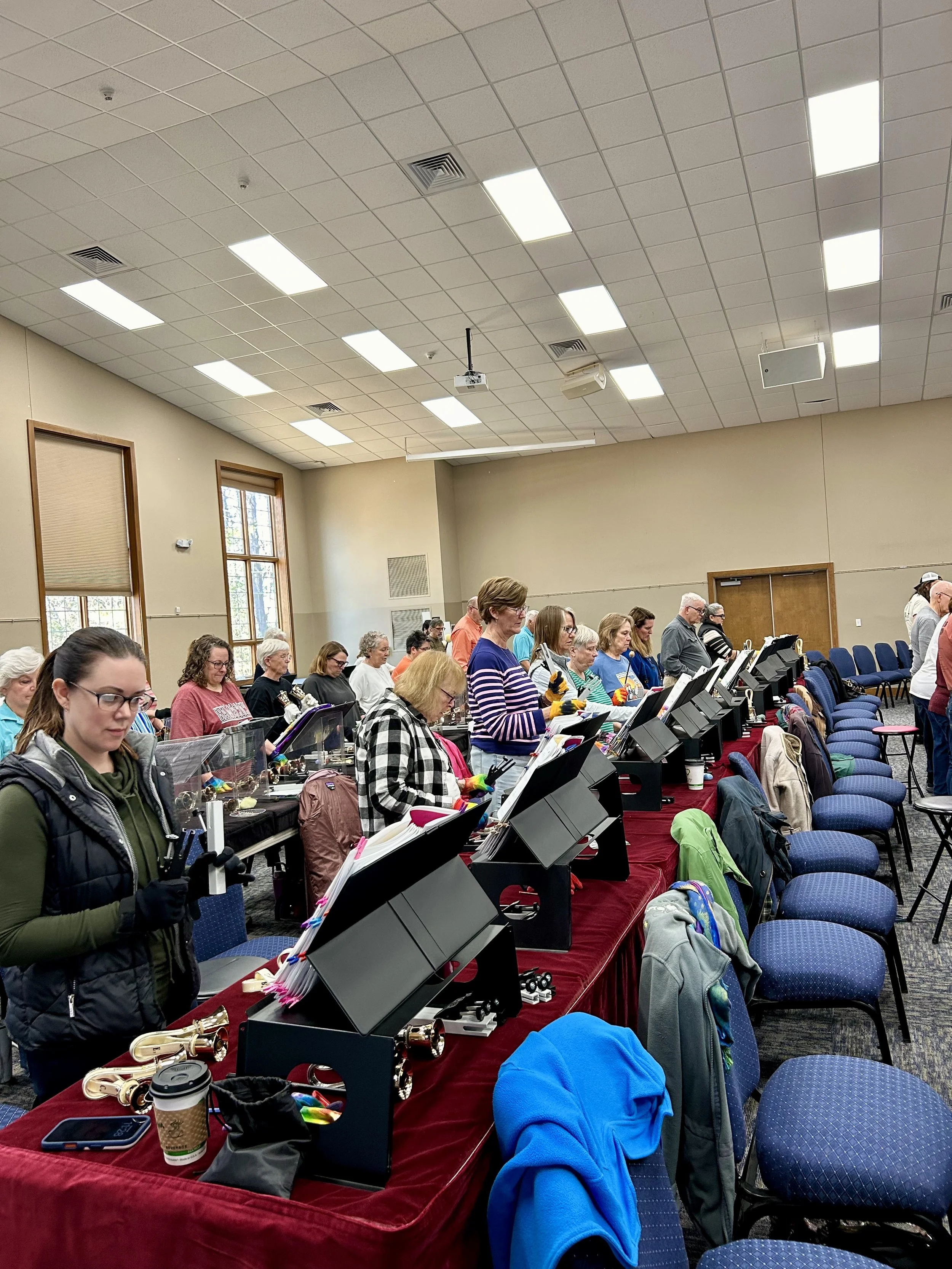
Handbells, in their modern form, originated in late 17th century by bothers William and Robert Cor as a tool for change ringing tower bands to practice. As there are thousands of change ringing towers throughout England, the handbell became a way for change ringing bands, as groups of ringers are known, to practice without having to practice in cold towers, or disturbing neighbors. Two change ringing towers exist in North Carolina. They are located at Christ Church, Raleigh, and at St. James Episcopal Church in Hendersonville. I invite you to watch the art of change ringing by watching a demonstration at St. James at the following link:
https://youtu.be/ErlAQbHc6Hw?si=007JKvlXHiCMzPtx
There is a fabulous video tour of American bell towers here:
https://youtu.be/g5ZaF8jlhGs?si=XqfSH2UTAVEEJ4ve
The end of the bell tower tour video features our friends at Christ Church, Raleigh. One of my great dreams is that a proper bell tower is added to the church at Emmanuel. It would serve as a physical beacon of hope and love, would provide elevator access to the rear gallery, and be equipped with a ring of bells for change ringing, an artform deeply married to our Anglican identity.
By the late 19th century, handbells evolved into their own separate artform, with bell manufacture primary in England. In 1963, Schulmerich Carillons began the manufacture of handbells in America. Malmark, the maker of the bells owned by Emmanuel, was formed in 1973. Together, Malmark and Schulmerich have allowed for the flourishing of the American love for handbells. Now, more than 25,000 handbell choirs practice this beautiful artform in the United States.
What I love about change ringing and handbells, is that it is an activity that cannot be done alone. It requires study, work, fellowship, community, and love. It is an artform that, with some patience, can be taught to most anyone. The joy of early success as well as the lifelong capacity to learn something new about the artform are rewards that makes handbell ringing so appealing.
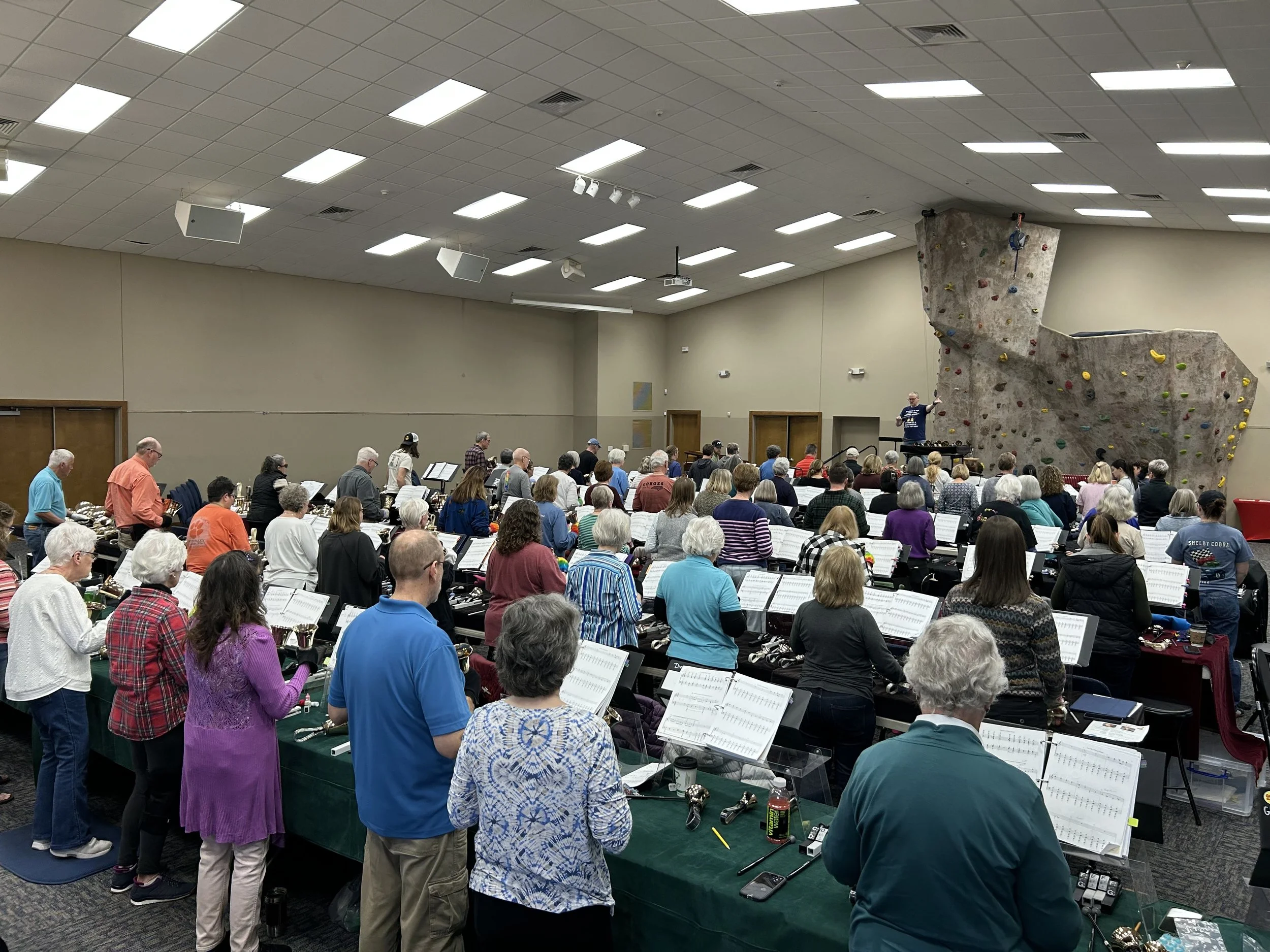
The weekend handbell retreat is divided into two levels. The intermediate, which includes our ringers, is the largest group, with over 100 ringers. Our clinician is Brian Childers, the fulltime handbell director at Myers Park United Methodist Church, where he directs six handbell ensembles. The music selected is of moderate difficulty, allowing refinement of the music, opportunity for technical study, as well as development of technique. The advanced group, of some sixty ringers, consists of ringers of the highest musical and technical ability. That group rings some of the most challenging repertoire composed for handbells and I always look forward to hearing their Sunday concert, as it is always a virtuosic musical marvel.
This is our third year attending this annual retreat and it has transformed the members of our Red Door Ringers. Not only have they become better ringers, but because of these retreats, they are better able to serve the church with their music, ringing with more heart than anxiety, and filling our intimate worship space with the sonorous beauty of bells. Their performance last Sunday of Let All Mortal Flesh Keep Silence was an offering of mystical beauty and because of their commitment to the artform, Sunday’s Bishop’s visit and confirmation were made all the more special. Through their music, they offered a bit of themselves, in thanksgiving to God.
It’s a real gift to spend the weekend with my ringers. It is a time work. It is a time to meditate. It is a time to meet directors and ringers from other churches. It is a time for competitive Uno card playing. It is a time away, on the mountaintop.
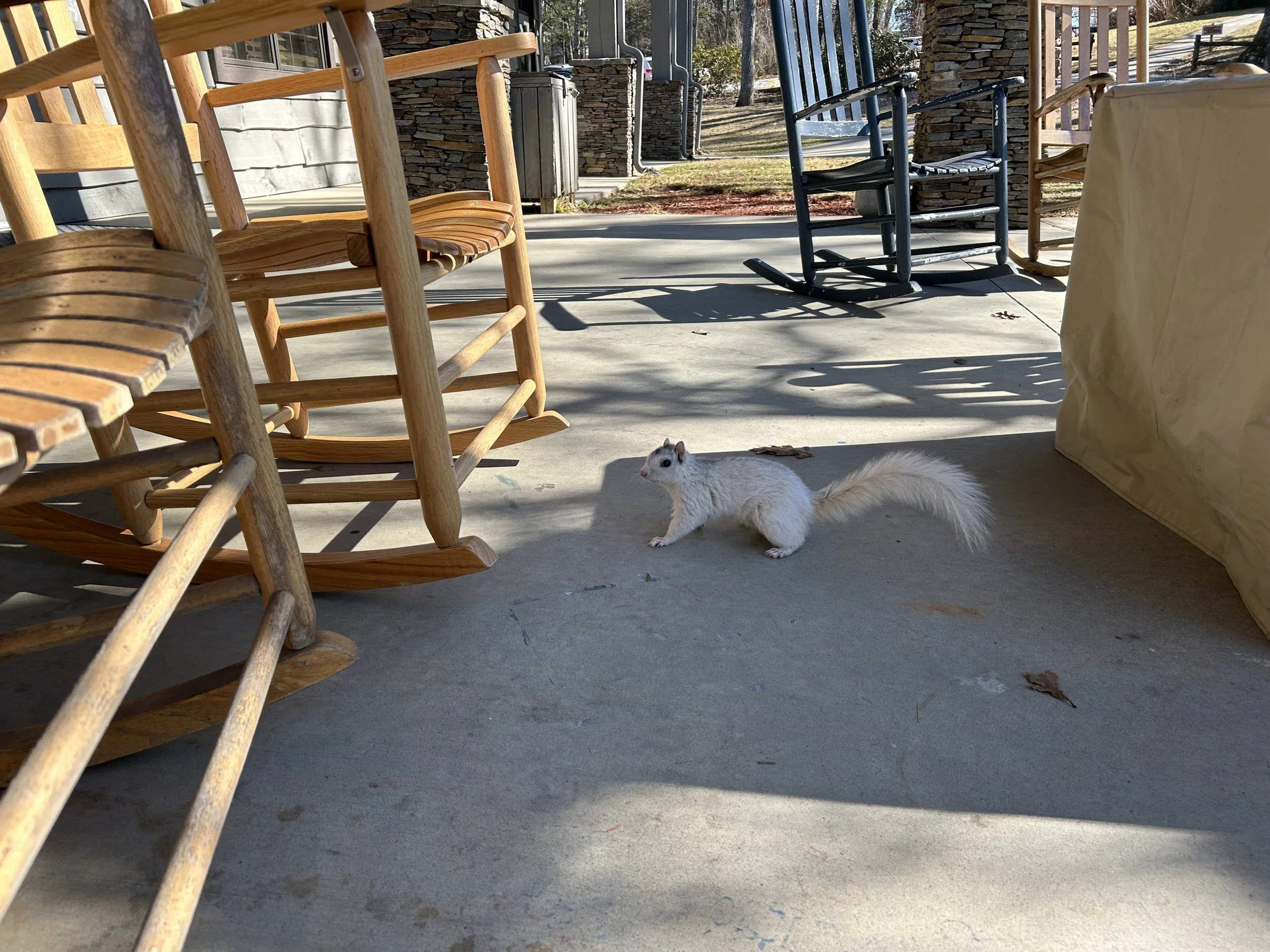
I didn’t have time to write this article before I drove to Asheville, my Wagoneer completely loaded with $72,000 worth of handbells, plus equipment. Halfway through the first morning rehearsal, I stepped away to write. I found a grouping of rocking chairs in the dappled sunlight. The air fresh and the birds singing. A white squirrel came very near and we exchanged pleasantries. At breaktime, several ringers were within earshot as they visited with one another. I overheard comments about the struggles of the modern church.
“How do you handle parishioners that complain that a minister preaches too long?”
“We have young families, but no one wants to teach Sunday school.”
“Our church is mainly old people.”
“My husband and I are musicians, so we always have something to say about the Sunday music.”
“I sure wish the organist would play the hymns faster.”
“If you don’t have God in there…it’s really tough.”
The comments are the words of humans. They are the words of struggle. They are the words of followers of Christ. As I look around and see all the people gathered here, each one of us is knit together, brought together, bound together, not just by music and handbells, but by God. Our ringers might be here partly because I inspired and encouraged them to come, but in reality, God gathered us together, to be together, and to do something together.
Perhaps that is the biggest lesson for me this weekend. For a variety of reasons, personal and professional, I’ve been on the struggle bus a bit lately. Managing more than sixty volunteer musicians, learning and studying and performing the music I need to have prepared each week, facilitating the vast amounts of administrative duties, and offering a music program that is akin to a major programmatic church as the single music staff member, can be exhausting. This time of year, in particular, I get weary. Recently, I am finding that I simply don’t have the same energy I did when I arrived at Emmanuel as a 15-year younger version of myself. But this morning, bathed in the morning sun on this mountaintop, listening to the faint sounds of handbells echo through the hills, I am remembering the words I heard just moments ago. If you don’t have God in there…it’s really tough. I am remembering that through the grace of God, I am here this morning. I’m remembering that I’ve been given a gift. I am remembering that in the center of it all, is God.
It might seem strange for a servant of the church to forget about God, but it happens. Sometimes your focus gets blurred. This morning through, I am reminded that each time we gather together, be it in rehearsal, on Sunday morning, or in retreat, that we gather together as children of God and because of God. My fellow ringer, whose name or origin I don’t know is right. Life is hard enough as it is, but if we don’t keep God in there, it is really tough. May we see each other that way, and we recognize each other, and ourselves, as loved children of God. Most importantly, may we do the things that we need to do to always keep God at the center.
Soli Deo Gloria.