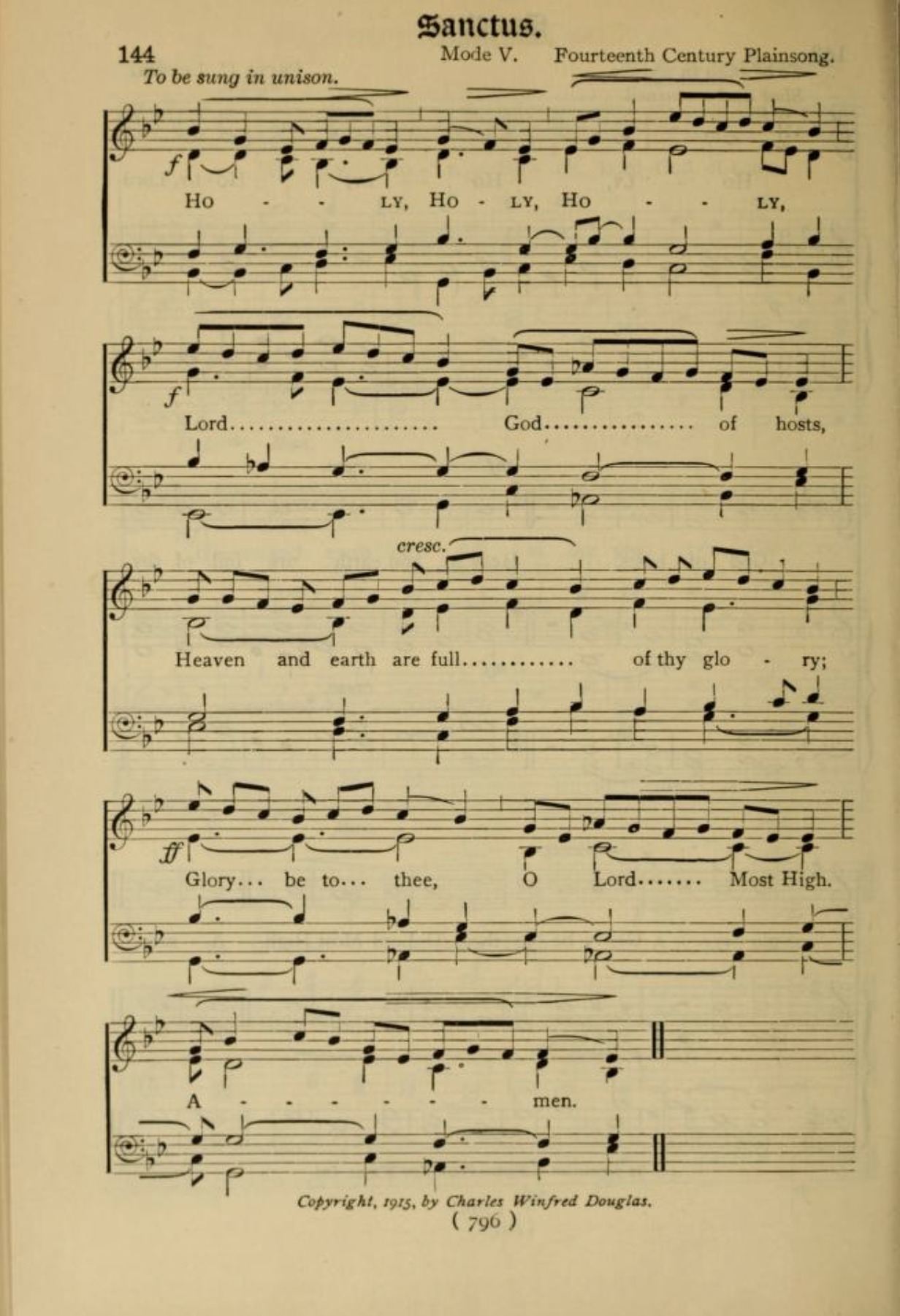
The Sanctus and Fraction Anthem – A Lenten Discipline
In Isaiah 6:1-8, the following is revealed:
In the year that king Uzziah died I saw also the Lord sitting upon a throne, high and lifted up, and his train filled the temple.
2 Above it stood the seraphims: each one had six wings; with twain he covered his face, and with twain he covered his feet, and with twain he did fly.
3 And one cried unto another, and said, Holy, holy, holy, is the Lord of hosts: the whole earth is full of his glory.
4 And the posts of the door moved at the voice of him that cried, and the house was filled with smoke.
5 Then said I, Woe is me! for I am undone; because I am a man of unclean lips, and I dwell in the midst of a people of unclean lips: for mine eyes have seen the King, the Lord of hosts.
6 Then flew one of the seraphims unto me, having a live coal in his hand, which he had taken with the tongs from off the altar:
7 And he laid it upon my mouth, and said, Lo, this hath touched thy lips; and thine iniquity is taken away, and thy sin purged.
8 Also I heard the voice of the Lord, saying, Whom shall I send, and who will go for us? Then said I, Here am I; send me.
The choir sang an anthem on this text in February of 2025 by David McKinley Williams. It is from this prophetic call that the acclamation “Holy, Holy, Holy,” that is, the Sanctus, became adopted in synagogue services. By the fourth century, the Christian church incorporated it into the Eucharistic Prayer as congregational song. Text from Matthew 21:9:
And the multitudes that went before, and that followed, cried, saying, Hosanna to the son of David: Blessed is he that cometh in the name of the Lord; Hosanna in the highest.
as well as text from Psalm 118:25-26,
25 Save now, I beseech thee, O Lord: O Lord, I beseech thee, send now prosperity.
26 Blessed be he that cometh in the name of the Lord: we have blessed you out of the house of the Lord.
was added to the Sanctus. Thomas Cramner (1489-1556), the Archbishop of Canterbury who served as the primary architect of the Church of England’s doctrine and liturgy, retained this text in the first Book of Common Prayer, 1549. However, in the 1552 Second Prayer Book of Edward VI, Cramner removed all except the paraphrase of the Hosanna (“Glory be to thee, O Lord most high”) perhaps because of the way the text had become associated with forms of the doctrine of the real presence that he had rejected. The Book of Common Prayer 1979 allows the restoration of the full text of the Sanctus with the Benedictus qui venit, but it removed the final Amen, giving us the present usage of this congregational song.
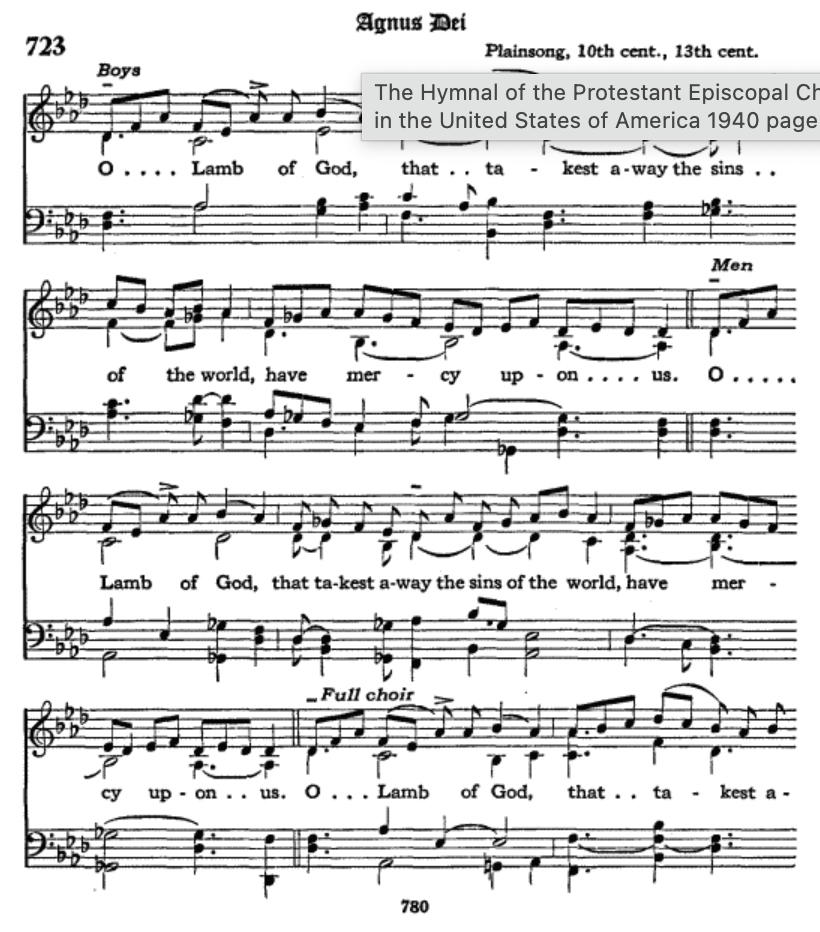
The fraction anthem, or confractorium, that is, an anthem sung during the breaking of bread before the distribution of communion, is found in many ancient eucharistic rites. The fraction anthem of the Roman rite is the Agnus Dei, which is a fixed part of the ordinary of the Eucharist.
In the Book of Common Prayer 1549, Cranmer included the traditional Roman anthem, the Agnus Dei, for use during the distribution of communion. The Book of Common Prayer 1979 makes provision for use of either the Agnus Dei or Christ our Passover as a fraction anthem at the Eucharist. (The rubrics allow the use of other texts as well.)
The use of Christ our Passover as a faction anthem in the Book of Common Prayer 1979 was suggested by the paraphrase of this text which Cranmer included in the Eucharist before the distribution of communion in the Book of Common Prayer 1549. The text of this anthem is drawn from 1 Corinthians 5:7-8,
7 Purge out therefore the old leaven, that ye may be a new lump, as ye are unleavened. For even Christ our passover is sacrificed for us:
8 Therefore let us keep the feast, not with old leaven, neither with the leaven of malice and wickedness; but with the unleavened bread of sincerity and truth.
Cramner maintained the structural framework and traditional sequence of the mass, as well as much of the aesthetic beauty of the Roman rite in the Book of Common Prayer 1549. That structural framework remains today, and the Sanctus and the Angus Dei are parts of the mass that connect us to our ancestral brothers and sisters in Christ.
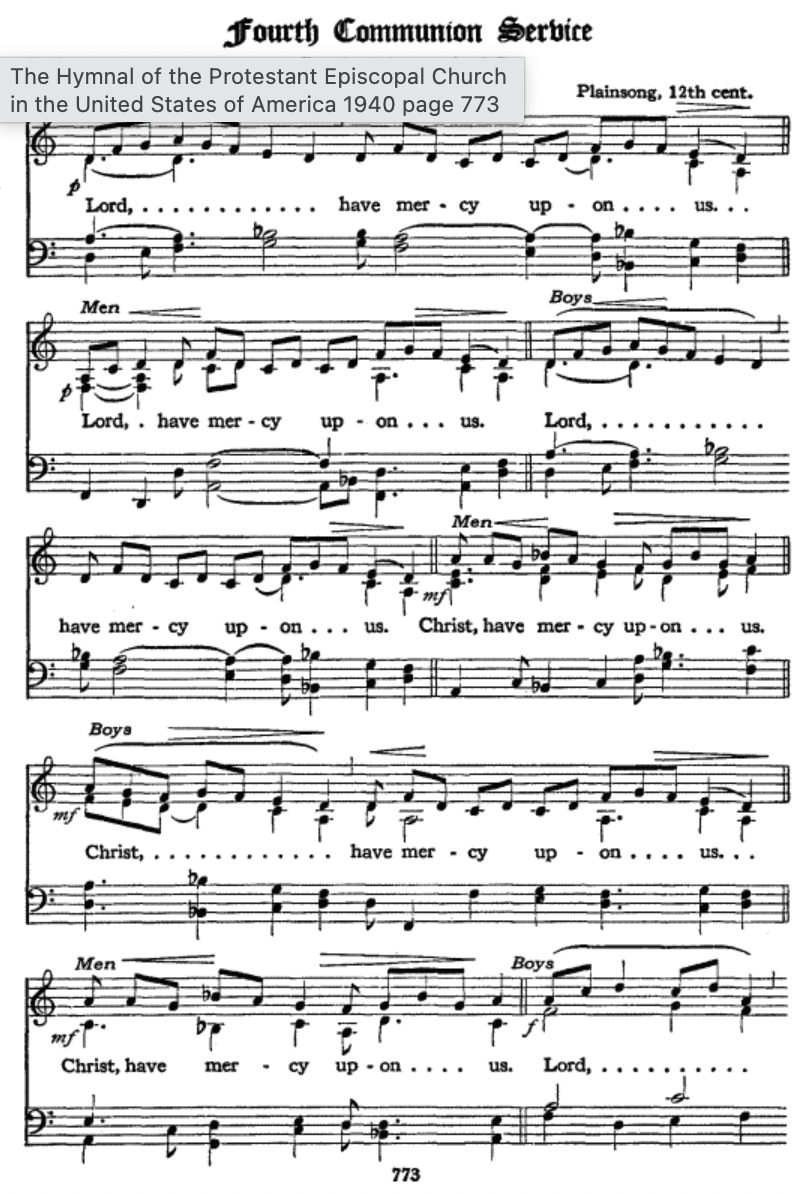
The Episcopal Church follows a liturgical calendar and with every change in liturgical season the service music is adjusted to reflect the new season. On Ash Wednesday, the musical settings of the Sanctus and the Agnus Dei were changed to plainsong settings. As part of our Lenten discipline, the settings we will be using for the season of Lent are Charles Winfred Douglas’s adaptations of the Kyrie, Sanctus, and Agnus Dei from Vatican Mass IX. These adaptations have been in use in The Episcopal Church since 1915. Douglas’s chant adaptation of the Sanctus was included in the 1916 Hymnal, a landmark publication which marked the first time a musical edition was officially approved for congregational and choral use. The Sanctus, as well as his adaptations of the Kyrie and Agnus Dei were published in both The Hymnal 1940 and The Hymnal 1982.
Also known as the Missa Marialis, these chant settings are used often during solemn seasons of the church calendar. Mass IX is a staple of the plainchant repertoire, known particularly for its beauty and accessibility. As the Book of Common Prayer 1979 has restored the Sanctus text to its more ancient form, Douglas’s musical setting has been adapted by Bruce Ford to reflect that change from the earlier versions found in the 1916 and 1940 hymnals. The Kyrie (Lord have mercy) and Agnus Dei (Fraction Anthem: O Lamb of God) in The Hymnal 1982 are unchanged from their previously published versions.
Plainsong won a significant place in the worship of The Episcopal Church primarily through the efforts of Charles Winfred Douglas. He demonstrated remarkable skill in adapting chant melodies to English words and provided American Episcopalians with chant settings of English-language liturgical texts that are aesthetically satisfying and respectful of the integrity of both text and music. For more biographical information about Rev. Canon Douglas, follow this link:
https://www.episcopalchurch.org/glossary/douglas-charles-winfred/
Chant is basically sung prayer, and it is suited to our contemporary faith communities just as it has been for monastic communities throughout history. Its basic simplicity allows and promotes the centering of prayer within a person. Through its use the community is able to gain from its unison song a sense of oneness as the body of Christ. Further, in plainsong we have a form of liturgical music in which the text is primary. The structure of the melodies to which the texts are set closely reflects the natural rise and fall of the language. In this way, the declamation is enhanced and enriched. To quote Richard Proulx and Raymond Glover, “When beautifully sung in an acoustically favorable environment and an appropriate liturgical context, plainchant can provide the worshipper a sense of the numinous, of the immanent presence of God.”
At 9:45 A.M., the choir will line the side aisles of the church so that as a congregation we can practice these ancient, nearly millennium old, sacred melodies as a path to prepare our hearts and minds for worship. For those that would appreciate further rehearsal, the Kyrie (S-92), Sanctus (S-115), and Fraction Anthem (S-159), are available for study at the following link:
https://youtu.be/6GLJXupeOSA?si=MLq4T3ksc0rBlJvr
A copy of The Hymnal 1982, or the available combined Prayer Book and Hymnal, are important at home devotional tools. These books are available for purchase at www.churchpublishing.org. Parishioners are welcome to borrow copies of The Hymnal 1982, as available in the choir room.