
“God, Life, You, & Me”
Over the past few weeks, I’ve made some changes to my personal behaviors, practices, lifestyle choices, and attitudes, that are, hopefully, for the better. One side effect of the pursuit for self-improvement has been attention to the organization of the spaces that I inhabit, specifically, my house.
Prior to last week, if you had seen my bedside table, you would have encountered a mountain of books and papers, lost kids’ toys, broken necklaces the girls had asked me to repair, notes to help me remember some fact or idea I wanted to retain, birthday and Father’s Day cards, golf tees, a few cough drops, photographs, loose coins and cash, and other assorted odds and ends. I decided enough was enough, and over the course of a few days, I used my free time to tackle this burden of miscellaneous stuff. Most of the items, as I expected, had real meaning, hence the placement on my nightstand. I put away the things that deserved a rightful place for saving, I organized the things that should have been organized long ago, tossed away the things I no longer needed, and discovered some things I had forgotten.
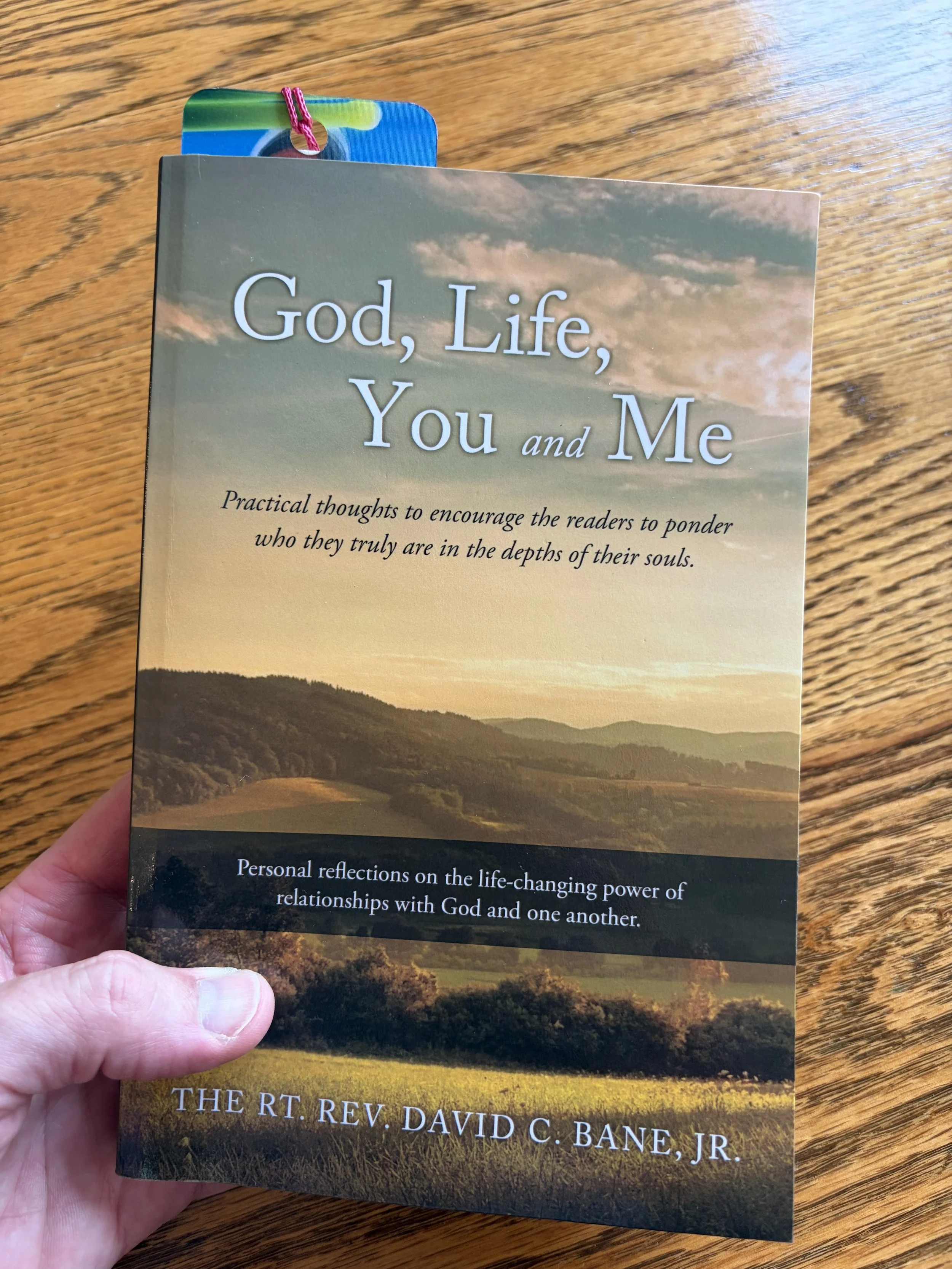
One of those items, tucked into the stack of books on deck for reading or study, was a book titled, “God, Life, You and Me,” a gift presented to me by Bishop David C. Bane, Jr., Emmanuel’s bishop-in-residence, that he wrote and published in 2021. It is subtitled, “Practical thoughts to encourage the readers to ponder who they truly are in the depths of their souls. Personal reflections on the life-changing power of relationships with God and one another.” I opened the front cover and inside he had inscribed, “For my friend, Homer 11/23/25.” I felt a bit ashamed to admit that I had forgotten that Bishop Bane had given me this gift, and that it had been almost a year before I even opened it.
I set the book aside as I continued my cleaning and organizing so I could examine it at bedtime. That night, I started with the first chapter, The Healing Power of Gratitude. Knowing Bishop Bane, I was struck by how his prose was the same as if we were having a conversation together over lunch, or if I was hearing one of his sermons. His honesty was refreshing and his wisdom and ideas are supported by years of experience, not specifically as a clergyman, but as a person, managing, exploring, and wrestling with the same questions and realities of the human experience that we all share.
After reading several chapters, I elected to make the book my nightly devotional. I have never been one to exercise the practice of a daily devotional, but after almost two weeks of doing so, I can report that the effort is life-changing. Instead of doom scrolling on my phone, now my thoughts before sleeping are focused on ideas and topics that are eternal. Instead of the hooks of clicking the next link to another negative news article, I am now pondering something greater than human concerns. To recognize God, to ponder the divine and the spiritual, and to let those ideas put me into a state of mediation and rest, is calming.
From 2002-2008, I served as the organist and music associate at Central United Methodist Church in Phoenix, Arizona. In that time, I became very familiar with the denominational hymnal, The United Methodist Hymnal, published in 1989, which was the primary resource for congregational song. There are many hymns in that hymnal that I miss, as they are not found in any of the hymnals of The Episcopal Church. Hymn #383 in The United Methodist Hymnal, is a hymn composed in 1978 by Brian A. Wren (b. 1936), titled “This Is a Day of New Beginnings.”
The verses of the hymn are as follows:
This is a day of new beginnings, time to remember and move on, time to believe what love is bringing, laying to rest the pain that’s gone.
For by the life and death of Jesus, God’s mighty Spirit, now as then, can make for us a world of difference, as faith and hope are born again.
Then let us, with the Spirit’s daring, step from the past and leave behind our disappointment, guilt, and grieving, seeking new paths, and sure to find.
Christ is alive, and goes before us to show and share what love can do. This is a day of new beginnings; our God is making all things new.
In faith we’ll gather round the table to taste and share what love can do. This is a day of new beginnings; our God is making all things new.
All week, I have been humming this hymn. Strangely, I haven’t thought of the tune or text in almost twenty years! Yet, here it has appeared out of the mist. This Sunday, we’ll sing it during the distribution of communion. As you consider the words, may this hymn and the act of taking in the body and blood of Christ, as the hymnwriter noted, allow us “to taste and share what love can do.”
God certainly has a way of making all things new. In Bishop Bane’s book, he writes in the chapter titled “A Personal Decision,” about Elijah.
When the prophet Elijah was trying to find God we read, “Then a great and powerful wind tore the mountains apart and shattered the rocks, but the Lord was not in the wind. After the wind there was an earthquake, but the Lord was not in the earthquake. After the earthquake came a fire, but the Lord was not in it. And after the fire came a gentle whisper…” (I Kings 19:11-12). Look and listen for the whisper…it is there every day.
God whispered to me when I rediscovered this book. David, thank you for this gift. I hope the Holy Spirit will guide others to it, too.