
Last weekend my in-laws were in town. The weather was so perfect that much of the time they were here, we spent outside enjoying the yard. On Sunday evening, as we were finishing our pizza dinner around the table on the deck, my son Ashton asked when the next time the International Space Station would fly overhead. Retired choir member Peter Helgesen often sends me a text when a good viewing of the ISS occurs, and Ashton had realized that we had not received such a notification in a while. I picked up my magic phone and discovered that 45 minutes later, the ISS would appear, starting at ten degrees above the horizon in the northwest. From my yard, the view of the horizon in that direction is blocked, however, I knew that if we walked onto the fairway of the golf hole that borders my property, we would have a splendid view.
Equipped with flashlights, ten minutes before the arrival time of the ISS we made our way to the golf course. The moon was rising brightly in the east, and after we navigated to the fairway, the flashlights became unnecessary as the nearly full harvest moon illuminated the soft turf grass. As published, the ISS appeared in the night sky at 8:53 P.M., orbiting 250 miles above us at a blistering 17,500 miles per hour. We watched it travel toward the south, directly in line with the fairway, growing brighter as it appeared higher in the sky. Then, three minutes later, as it neared completely overhead, it disappeared in the earth’s shadow.
(If you want to view the ISS, you can find information about when it is visible in your area here: https://www.nasa.gov/spot-the-station/)
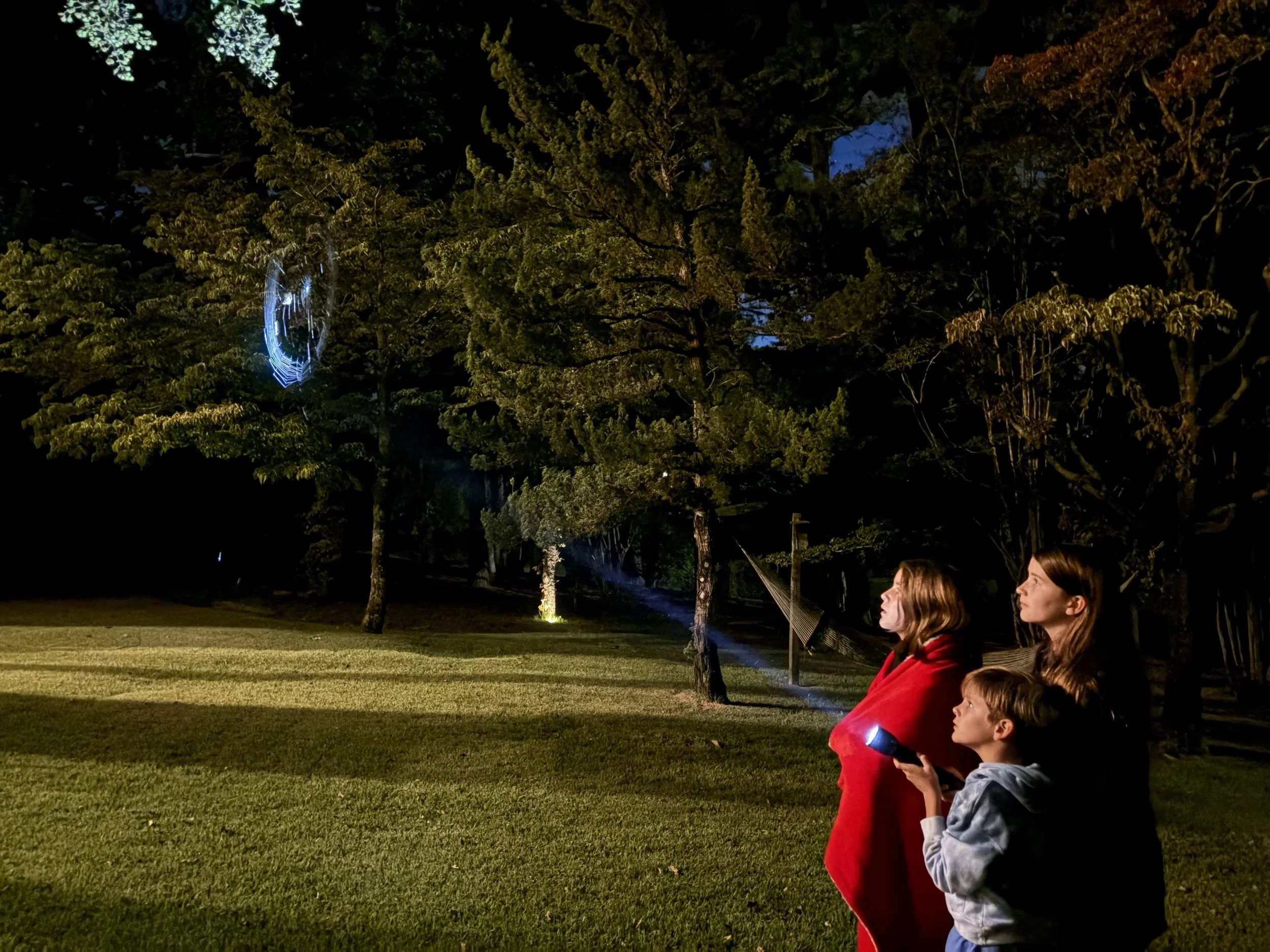
Each time I see the ISS sail overhead I am in awe, and this time was no different. We even saw two shooting stars while we observed this creation of man fly past us. After a few minutes identifying constellations, we walked back toward the house. As we walked up the hill in the backyard, the beam of my flashlight reflected on a very large spider web suspended across the grass. It had not been there when we walked through that same spot twenty minutes before. There, working quickly and diligently, was a large orb weaver spider spinning its web for the night. It was an aha moment, as I had encountered a single anchor line of silk several times in the past few weeks that stretched twenty-three feet from a cedar tree to a crepe myrtle. We stood there, mesmerized, watching this incredible architect weave something that would only last a night. Each day, the orb weaver spider eats its nocturnal web, recycling up to 80 percent of the silk proteins from their old web by consuming it before spinning a new one.
What struck me in that moment, watching that spider quietly work, undeterred by the brightness of my Maglite, was how my children and I found the work of the spider as awe inspiring, and perhaps even more so, than the ISS we had just watched. As the spider’s web grew larger and as we admired the engineering behind its design, we found that we simply could not stop watching the development of its web. I think we all sensed in our mind what the web would be once completed, but the marvel of its building had us spellbound.
As this week progressed, I thought about that moment several times. What had captured us so completely? I am writing this piece on the morning of Friday, October 2nd and just a few minutes ago I went to check on my orb weaver spider. Remnants of last night’s web were in the near exact location as the one we encountered on Sunday night. The web had served its purpose, but it appeared like a town past its prime. It was no longer pristine. Strands were broken. The spider was nowhere to be found. As I turned to go back inside, I noticed high in the trees, suspended between the cedar and an adjoining dogwood tree, the majesty of another orb weaver’s web. Aha! She had a friend!
I realized what had transfixed my family. There is something incredibly special about that spider that the ISS does not have. Like us, it has been given the gift of life. It is a living, breathing creation of God. The miracle of life. Life! Man may be able to manipulate it, but we cannot create it. In a world where the news cycle is filled with stories of AI, where human behavioral addiction has been leveraged to the benefit of cell phone manufacturers and corporations buying your attention, they simply lack one basic, yet vital element, the sanctity of life.
In my first years at Emmanuel, under the rectorship of John Tampa, each October was celebrated as a Season of Creation. Laurie Holden was brilliant at gathering pieces that were used to compile a Season of Creation devotional. Even though we do not order our liturgical life at Emmanuel in the same way anymore, that recognition of God’s creation, of life, and of the miracle of it all, still gives me pause each October. This Sunday is the Feast of St. Francis and his devotion to the poor, and his deep love for nature and animals made him the patron saint of animals and ecology. Musically, we will sing hymn #400 All creatures of our God and King, as the recessional hymn in recognition of his feast day.
Additionally, we will sing hymn #431 The stars declare his glory, at the distribution of communion. I was first introduced to this hymn at the request of Mollie Wilson, who noted that it was her favorite. The hymn is a contemporary paraphrase of Psalm 19 by Timothy Dudley-Smith (1926-2024), a bishop of the Church of England and an influential British hymn writer. The text first appeared in Psalm Praise (London, 1973).
Of this text Bishop Dudley-Smith writes:
The Psalm itself combines the two themes of the eloquence of nature and the clarity of scripture…The thought of “order” in the final verse may be going beyond the immediate meaning of the psalmist; but it is not, I think, inconsistent to ask that he who orders the heavens and gives the stars their laws will also direct and order (within the bounds of their own freedom) the lives of his children, according to the laws he makes for them.
The unison tune ALDINE was written in 1983 by Richard Proulx (1937-2010) for use in The Hymnal 1982 with this text. Very songlike in nature, the setting has a flowing accompaniment filled with “harmonic richness.” The final cadence nods at the work of George Gershwin and the tune name honors the street in Chicago where Mr. Proulx resided.