
Handel’s Messiah has eternal popularity. In November and December, performances of the work, either in part, or in its entirety, are staged and heard all over the world.
As a boy, I remember performances held all over the city of St. Louis. My hometown orchestra, the Belleville Philharmonic, continues to make it a regular offering. Their performance of it this year will be held at the Cathedral of St. Peter. The Gothic Revival Cathedral, modeled after the Cathedral of Exeter in England, has a seating capacity of 1,270 and is home to the Diocese of Belleville. It is the largest cathedral in the state of Illinois, and the performance of Messiah will fill most of those seats.
In North Carolina alone, Messiah will be performed this month and next by the North Carolina Symphony, the Charlotte Symphony Orchestra, the Winston-Salem Symphony, and the Asheville Symphony. Community and regional groups will perform at The Sharon at SouthPark, First Baptist on Fifth in Winston-Salem, First Presbyterian Church in Kinston, Grace Lutheran in Hendersonville, Greater First United Baptist Church in High Point, St. Philip’s in Brevard, and Duke Chapel, just to name a few.
In Moore County, the earliest reference to the performance of the Hallelujah Chorus from Messiah is a review of an instrumental performance given by the Holly Inn Orchestra in 1900. In 1923, a performance of this famed chorus was sung in the Pinehurst Theatre as part of the Sandhill Fair. A December 13, 1929, article from The Pilot is titled, “Baptist Church Choir Greeted by Throng – Southern Pines Church Filled to Capacity to Hear Hallelujah Chorus.” The choir was led by E.E. Giles, who was the hired musician at Emmanuel from February 1, 1926, to June 1, 1927, before moving to the larger Baptist Church, which had a choir and offered a higher salary.
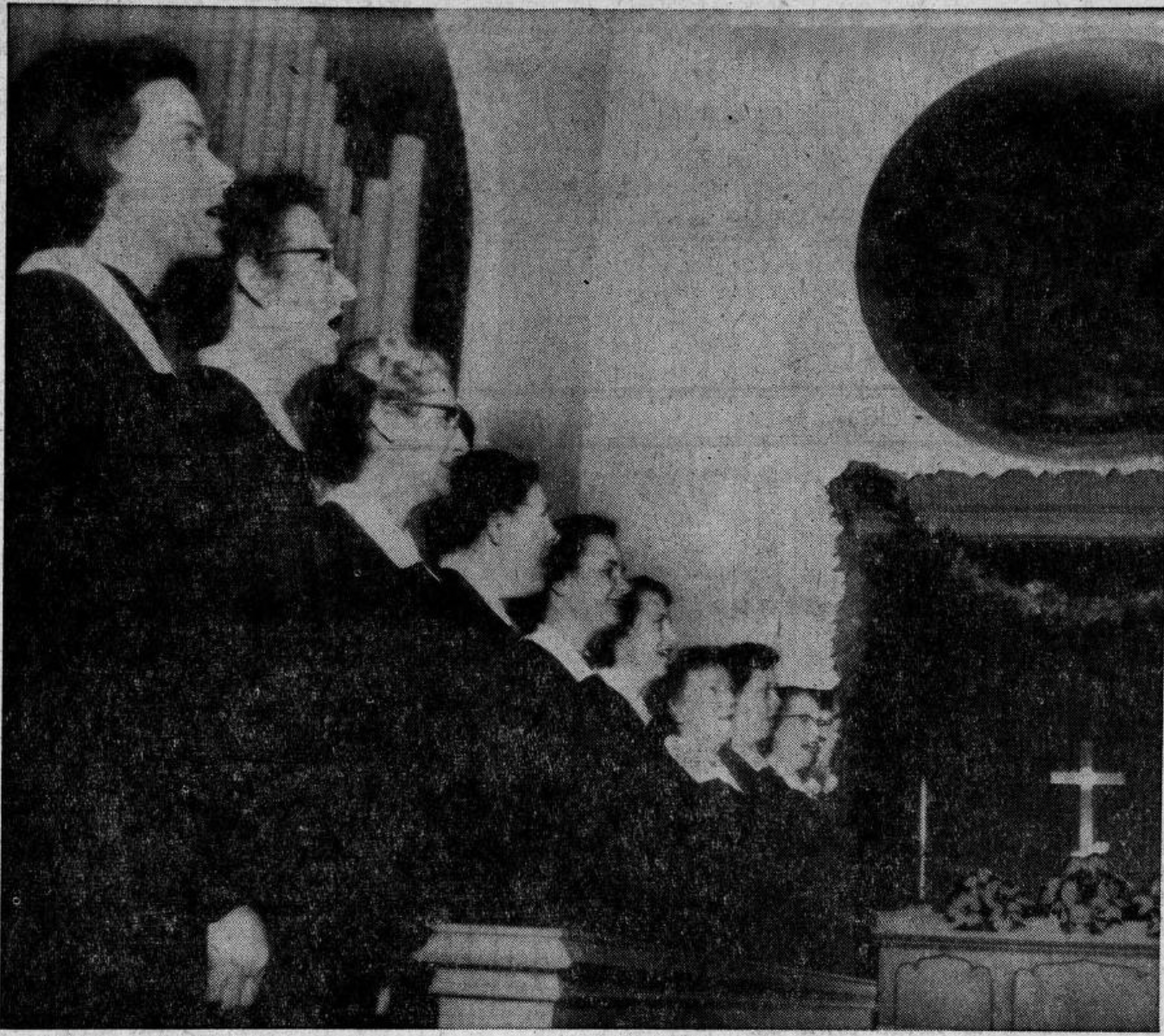
The first performance of Messiah in Moore County in any complete form took place in December 1954 at Page Memorial Methodist Church, Aberdeen, by the choirs of the Methodist, Baptist, and Presbyterian Churches, under the direction of E. H. Poole. Not to be outdone by the choirs of Aberdeen, in 1955, the choirs of Brownson Memorial, Church of Wide Fellowship, Emmanuel Episcopal, First Baptist Church, and Southern Pines Methodist, joined forces to offer two performances of Messiah at Church of Wide Fellowship and Brownson. (The photo is an image of the December 18, 1955, performance at what is now Community Congregational Church.)
Many communities have a “Messiah church,” known for annual offerings of Handel’s masterwork. For an extended period in the 1960s and 1970s, that designation went to The Village Chapel in Pinehurst, with documented performances held there in 1964, 1965, 1966, 1967, 1968, 1969, 1972, 1973, 1975, and 1978 (and perhaps others). The Moore County Choral Society gave a performance in the Southern Pines Elementary Auditorium in 1981. First Baptist, Southern Pines, became the “Messiah church” for a period under the direction of Benny Edwards in the early 2000s.
While the Emmanuel Choir and choristers have given two performances of excerpts from Part One of Messiah on Christmas Eve in 2019 and 2025, our church has never offered a formal presentation of Messiah.
I’ve had several conversations in recent years with our current and past rectors about how Emmanuel should be the “Messiah church” and how performances of the work would be an evangelistic outreach opportunity. Early in his tenure, Fr. Morris shared with me the memories of the beauty and holiness he experienced in his youth at Christ Church Cathedral in Lexington, Kentucky, where the choirs give an annual performance of Messiah, filling the 700-seat Cathedral.
As much as I dream of Emmauel becoming the “Messiah church,” the immense popularity of the work and the crowds it draws creates logistical challenges. When our church is arranged in concert formation, where the transept and chapel spaces become unavailable, our maximum seating capacity is 225. We are equipped and offer many moments of musical beauty, holiness, and respite to the community throughout the year, but for now, becoming the “Messiah church” is not a compatible dream with the intimacy of our building.
That musical yearning was heard, and in 2021, The Village Chapel became the “Messiah church” again, with a performance of Part One + Hallelujah Chorus, conducted by Director of Music Stephen Gourley. I played harpsichord for that performance. Nearly 500 were in attendance and the choir and orchestra received a standing ovation that seemed to never end.
This Sunday, November 15th, the light and truth of the Gospel will be told again with a performance of Messiah (Part One + Hallelujah Chorus) at The Village Chapel at 4 P.M. Unlike the 2021 offering, which was a concert performance, Sunday’s offering will be a Messiah Community Sing-Along. There is no formal choral rehearsal. If you want to sing, bring your Messiah score and come! It all starts at 4 P.M. and it will be great fun!
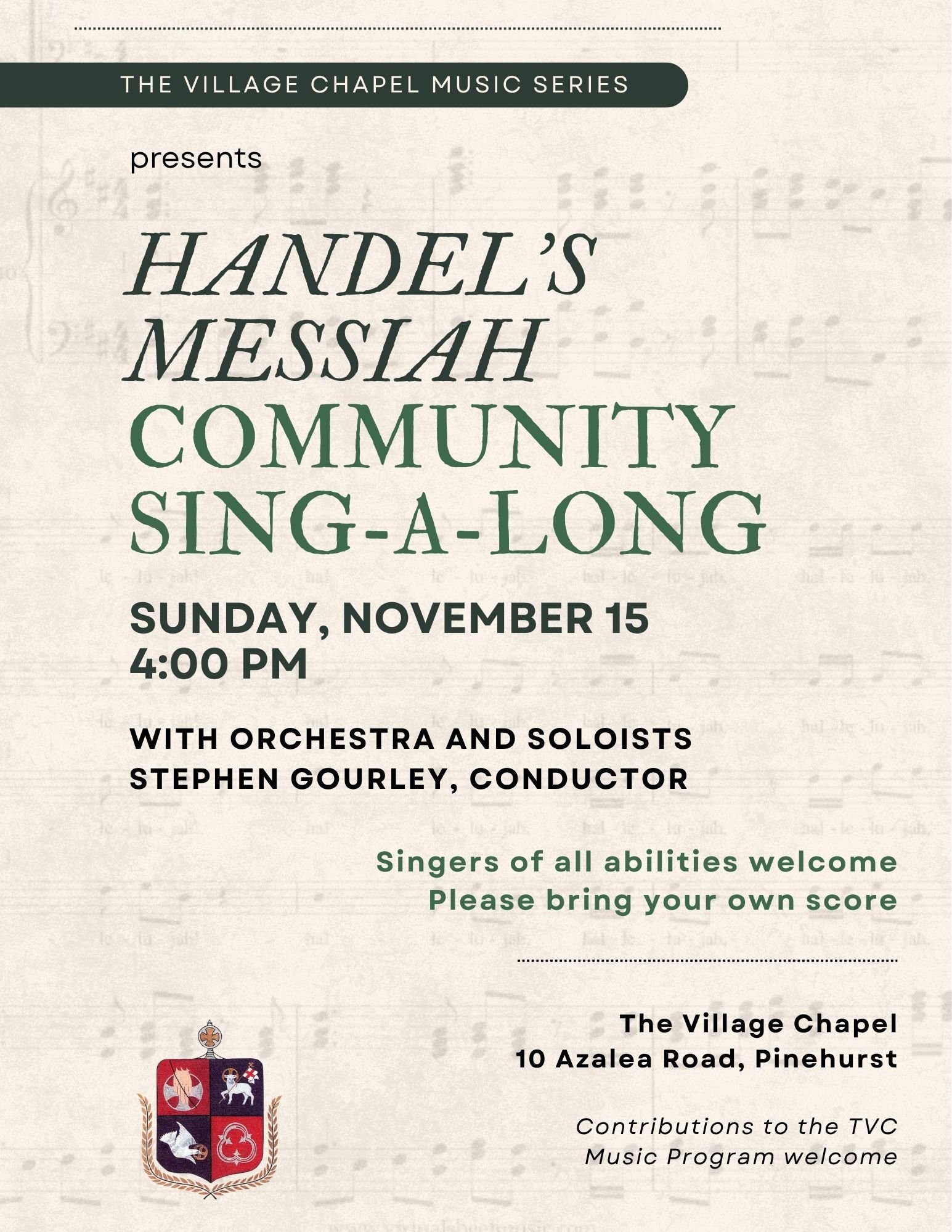
If you need to borrow a score, we have plenty in our choral library. You are welcome to borrow a score from our parish. Please see me or Marilyn Neely before or after church on Sunday and we’ll provide a score for you to borrow.
In a 2025 article, author Sally Bradford compiled 12 Messiah Facts and Myths. How many of these do you know?
12 HANDEL’S MESSIAH FACTS AND MYTHS
1. Handel wrote Messiah intending it to become the great musical ode to Christmas.
False. Messiah was originally conceived as a work for Easter, and its world premiere was given during Lent.
2. The world premiere of Handel’s Messiah was given in London.
False. While Handel later gave regular performances of Messiah at London’s Foundling Hospital, the oratorio was first performed in Dublin, at the Music Hall on Fishamble Street, on April 13, 1742. The concert benefited three local charities.
3. This first performance featured 50 musicians on stage.
True. The premiere of Messiah featured 50 musicians, evenly divided between members of the chorus and orchestra. This is why historically informed ensembles approximate this number of musicians for Messiah performances.
4. The U.S. premiere of the complete Messiah was performed in Boston.
True. The U.S. premiere of the complete Messiah was performed by the Handel and Haydn Society on Christmas Day in 1818 at Boylston Hall in Boston. The building that housed Boylston Hall was demolished in 1887.
5. Handel wrote both the words and the music for Messiah.
False. Charles Jennens wrote the libretto, or text, comprising passages from the Bible.
6. Handel’s Messiah is divided into three parts.
True. Messiah contains 53 songs, referred to as movements that are grouped into three parts. Part I tells of God's plan to redeem humankind through a Messiah and the birth of Christ; Part II covers the death and resurrection of Christ; and Part III emphasizes the promise of resurrection and glorification of Christ.
7. Handel composed the complete Messiah in London in under a month’s time.
True. Handel composed Messiah in a breathtakingly swift 24 days, working primarily in his house on Brook Street in London.
8. Messiah is Handel’s longest composition.
False. While Messiah is a large-scale oratorio that takes almost 3 hours to perform in its entirety, it is not Handel’s longest work.
9. W.A. Mozart arranged an orchestration for Handel’s Messiah.
True. There are various arrangements; Mozart wrote one of them in 1789 for performances that took place in the homes of Vienna’s nobility.
10. The “Hallelujah” Chorus from Messiah was performed in celebration of Abraham Lincoln signing the Emancipation Proclamation in 1863.
True. The Handel and Haydn Society performed the “Hallelujah” Chorus at the Grand Jubilee Concert held on New Year’s Day 1863 in Boston in celebration of the news that Lincoln signed the Emancipation Proclamation.
11. The first nationally televised broadcast of Handel’s Messiah was in 1963.
True. The Handel and Haydn Society performed in the first nationally televised broadcast of Messiah in December 1963 for National Educational Television (WGBH).
12. Audiences are required to stand for the “Hallelujah” Chorus.
False. There is a long-standing myth that at one of the first performances of Messiah in London in 1743, King George II was so touched by the “Hallelujah” Chorus that he rose to his feet and the crowd followed. It’s hard to document the truth of this legend, since the first record of this event was written in 1780, almost 40 years later.